Most pet brands don’t need to invent your next great freeze-dried SKU from scratch.
A lot of the time, it’s already sitting in your supply chain — in trim streams, byproducts, cosmetic seconds, or inputs you’re currently overlooking.
Often, freeze-drying can provide the opportunity to turn those inputs into premium pet products.
Plus, if it’s done well, it can eliminate cold-chain headaches, extend shelf life (often 18-24 months, sometimes longer with the right packaging and storage), and convert cost centers into revenue by pulling inputs out of waste streams.
“The best new SKU idea is often already in your supply chain,” says Sean Jones, sales director at Glacial Freeze Dry. “The work is figuring out if it can be made, sold, and repeated without the math falling apart.”
So how do you determine if your underused input is the right one to freeze-dry and hit the shelves?
Why this matters right now
Today’s consumers are increasingly seeking premium products to feed their pets, with maximum nutrition, transparent sourcing, and better quality. Meanwhile, companies are chasing higher gross margin, less waste and write-offs, more resilient sourcing, and faster innovation cycles with less risk.
Freeze drying can serve as the solution for both sides because it preserves what buyers want while helping brands pursue margin, value-added pricing, supply chain advantages, and upcycling.
“Freeze-dried isn’t just a format shift,” Jones says. “It’s a way to protect the value of real inputs and make them easier to ship, store, and sell.”
A practical framework for pressure-testing novel ideas
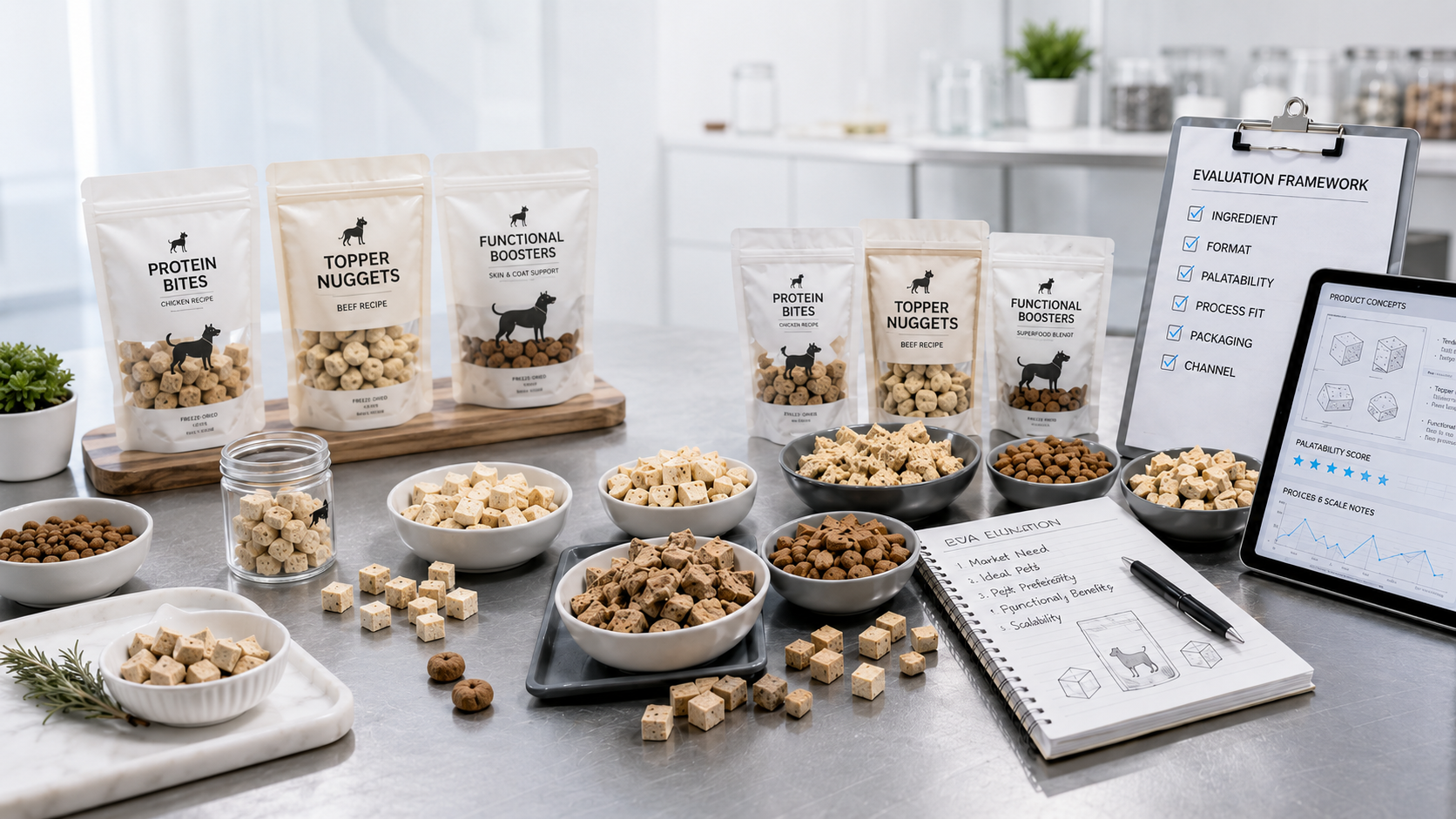
Jones recently presented this framework at Petfood Forum, designed to keep you from pitfalls in evaluating your input idea.
It includes six checkpoints:
- Identify potential inputs
- Market + price hypothesis
- Raw material costs
- Processing requirements
- Packaging + distribution
- Conduct an overall review
Step 1: Identify potential inputs
Start by mapping what you already have.
Ask:
- What are your byproducts right now?
- What’s in your waste streams and why is it there?
- Is there a higher and better use for inputs currently directed to other formats?
- What doesn’t freeze-dry well (or at least, doesn’t freeze-dry easily)? Think fats, oils, sugars.
“A lot of teams jump straight to ‘what’s interesting,’” Jones says. “Start with what’s available and underused, then get brutally honest about what won’t behave in freeze-dry.”
Step 2: Market + price hypothesis
This step is where some ideas die — and that’s a good thing.
Ask:
- Will consumers value this input in a freeze-dried format?
- Does it pass the palatability test (flavor, aroma, texture)?
- What price range can the market support?
Remember: Just because it’s available doesn’t mean people will buy it.
“Availability is not a strategy,” Jones says. “You need a story a pet parent understands, and a price that still lets everyone in the chain win.”
Step 3: Raw material costs (high-level reality check)
Before you proceed further, you need a reality check on costs.
Ask:
- Is supply consistent and reliable?
- What’s the anticipated yield?
- Can we process it safely?
“If supply is erratic or yield is unpredictable, what seems like a great idea can become a constant fire drill,” Jones says.
Step 4: Processing requirements
This is where “simple input” can easily become a “complex product” if you don’t evaluate it’s processing completely.
Ask:
- Does it require dicing, grinding, mixing, milling, or other preprocessing?
- What’s the estimated batch time?
Bringing a freeze-dried product to life also includes front-end processing and back-end packaging/distribution add time, cost, and complexity.
“Most surprises don’t happen in the dryer,” Jones says. “They happen in prep and pack-out.”
Step 5: Packaging + distribution
A product that looks great at the line can fall apart in the channel.
Ask:
- How automated or manual is packaging?
- How does product integrity hold up through distribution?
This is also where you pressure-test shelf life expectations. Freeze-dried shelf life is often 18-24 months, but it can be longer with the right packaging and storage, so packaging decisions matter.
“Packaging shouldn’t be your last step,” Jones says. “It’s a core part of whether the product survives the real world.”
Step 6: Overall review
After you’ve walked carefully through the proceeding steps, you need to pull back and evaluate whether signals point to moving forward.
Ask:
- Is the product operationally complex?
- Is any step significantly costlier than the others? If so, why? Can it change with equipment, process changes, or scale?
- Is this the best use of freeze-dryer capacity available? The closer you are to capacity, the higher this bar gets.
- Is there enough margin for wholesale and retail? Does the math work in more than one channel?
Pilot and beyond: How to learn without wasting time
Once an idea clears the framework, treat the pilot like a controlled learning loop.
Jones says this should include three parts: Define what you’re measuring, right-size the scope, and decide what success means.
Define and measure:
- Purpose: Product, process, and price
- Scope: Get to the “Goldilocks” sweet spot, where the pilot is big enough for real data, small enough to avoid wasting resources
- Success: Operationally, financially, and commercially
Then do a look-back review and stress-test assumptions vs. real data, especially yield, labor creep, and packaging choices.
“A pilot should teach you what breaks,” Jones says. “If you aren’t measuring the assumptions, you’re just making samples.”
Novel Product Examples: Easy, moderate, difficult
Not all novel ideas are equal. Jones gives three examples on the benefits and frictions for bringing your pet product to market using underutilized inputs.
Easy: Beef heart
- It offers a strong market story with “superfood” positioning and established demand range
- Supply is steady, yield is good, and food safety fairly straightforward
- Requires minimal processing (dicing), packaging can be automated, integrity holds up
- Overall: not operationally complex; good use of dryer capacity; margin holds
“If you want a safer innovation bet, look for ideas with demand proof and operational simplicity,” Jones says.
Moderate: Duck heads
- Strong functional story and market price range
- Supply is steady, but size limits production volume; food safety needs attention in harvest/transport
- Whole ingredient (less preprocessing), but packaging more manual; batch time depends on technology partner
- Overall: higher processing expenses, but can be a good use of excess capacity
“The ideas that fall into the moderate category aren’t bad,” Jones says. “They just mean you need to plan for labor, handling, and pack-out.”
Difficult: Spent hens
- Offers a nutrient-dense story, but yield is not good and food safety development is needed post-laying (harvest, cold chain, processing)
- Labor-intensive processing costs can dominate; operational complexity climbs
- Overall: cost imbalance can make it a poor use of dryer capacity; margin falls apart
“The hard lesson is this,” Jones says. “Some inputs look perfect nutritionally, but operationally they’re capacity and margin killers.”
Where the market is headed
The broader trendline matters because it affects how you price, position, and forecast.
Here’s where Jones says momentum is at:
- Previously overlooked ingredients are already being used
- Treats paved the way for freeze-dried adoption
- Toppers surged in 2025 and are still climbing
- Functional nutrition is expanding in distribution and adoption
- Consumers want new pet food formats that still fit the convenience of kibble and canned
The question isn’t always whether the demand exists; it’s whether you can do it profitably and repeatedly.
A simple way to use this framework tomorrow
How do you put this framework into practice? Jones suggests you try thiswith your team:
- Map 5 potential inputs from byproducts, waste streams, or underused supply lanes.
- Run each through the six checkpoints above.
- Pick the top 1-2 that score well on demand clarity, operational simplicity, packaging survivability, and capacity fit.
“Innovation gets a lot cheaper when you stop guessing,” Jones says. “A simple framework can turn your cool idea into a decision and your underutilized inputs into margin.”
FAQ
What qualifies as a “novel” freeze-dried idea?[Text Wrapping Break]Usually it’s an ingredient stream or format you aren’t selling today, especially one currently treated as secondary value (trims, byproducts, cosmetic seconds, seasonal overruns).
What’s the biggest mistake teams make evaluating novel ideas?[Text Wrapping Break]Skipping market and operational reality checks. If you don’t validate the consumer value and the process practicality, you’ll learn the hard way later.
Do I need perfect cost data before I decide?[Text Wrapping Break]Not at the first pass. But you do need to pressure-test supply consistency, yield expectations, processing requirements, and packaging realities early, because those are where surprises stack up.
Why does packaging matter so much for freeze-dried?[Text Wrapping Break]Because it’s a key driver of integrity in distribution and a major lever on shelf life and repeatability. A fragile product in a weak package becomes returns, complaints, and rework.
How do I know if an idea is a bad use of freeze-dryer capacity?[Text Wrapping Break]If it’s operationally complex, has a major cost imbalance in one step, or ties up capacity without delivering margin across channels, it’s usually a sign to pivot.
Comments are closed