
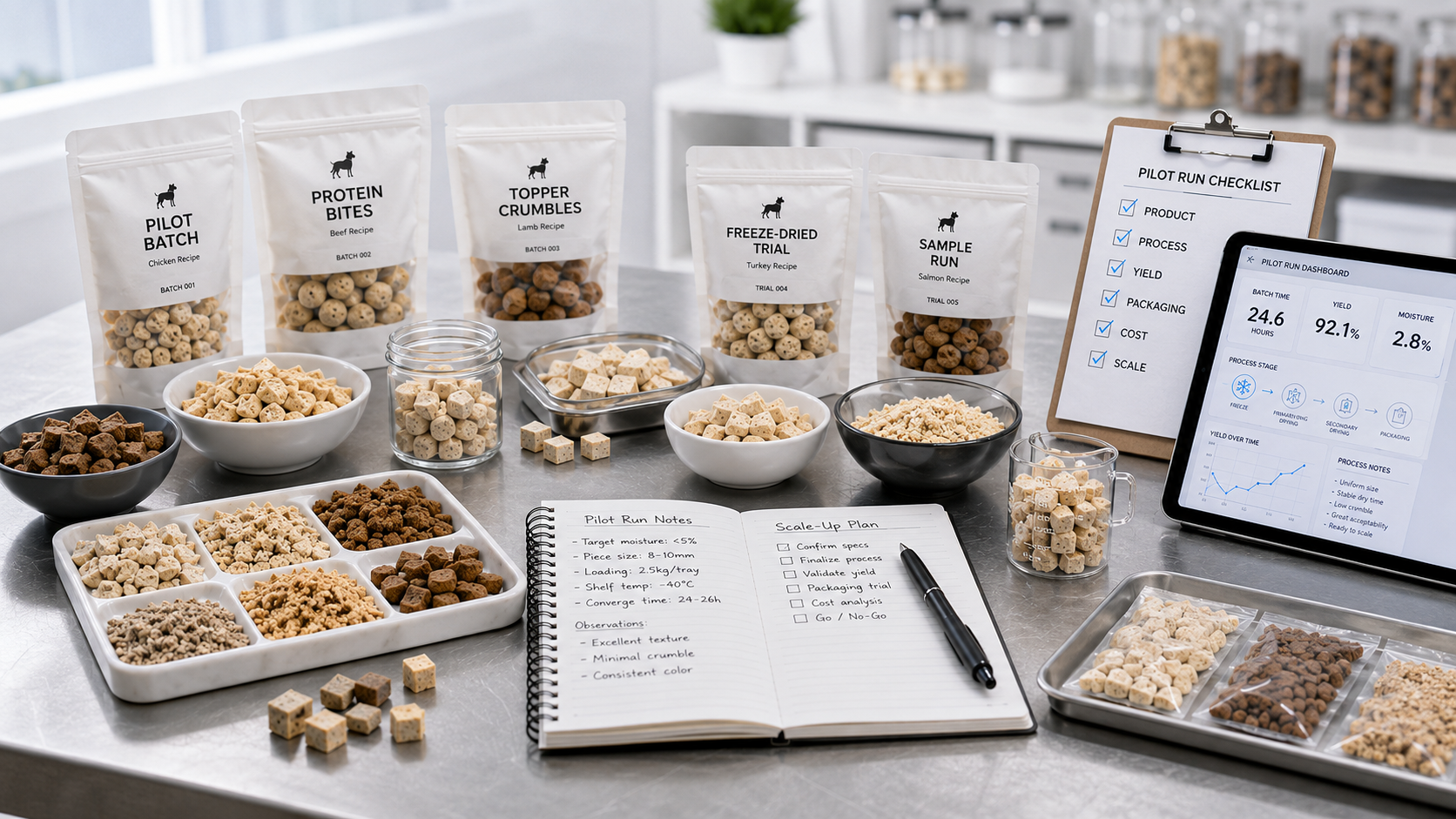
Getting to the stage where you’re ready to do a freeze-dried pilot run can be exciting.
You finally get to see the product take shape. You can start picturing it on a shelf or in a customer’s cart.
But a pilot run has a bigger job than producing a good-looking sample.
“A pilot run has to answer the harder question: Can we do this again, at the right quality, cost, and scale?” says Sean Jones, sales director at Glacial Freeze Dry.
If you’re preparing to pilot run a freeze-dried product, here’s what you need to know.
Quick takeaways:
- A pilot run should test product, process, and price, not just appearance or palatability.
- The scope needs to be large enough to generate useful data, but small enough to avoid wasting resources.
- The best pilot runs define success before production starts.
- Use the same raw materials and equipment whenever possible, so the data reflects real production.
- The look-back review is where you decide whether to scale, adjust, or stop.
A pilot run is not the finish line
Some brands treat a pilot run as proof that the product works.
However, in freeze-dried manufacturing, a pilot run is better understood as the beginning of proof.
It’s where the idea meets the realities of raw material handling, preprocessing, freeze-dry behavior, packaging, distribution, labor, yield, and repeatability.
A successful pilot run run should help you learn:
- Can the product be made consistently?
- Can it hold up through packaging and distribution?
- Are the early cost assumptions realistic?
- Does the product fit the intended channel and price point?
- What needs to be locked in before repeat production?
“The pilot run is where the idea meets the floor,” Jones says. “It’s where you find out what the product needs from your process. It’s about moving from hopes and plans to reality.”
Start by defining what you want to learn
Before a pilot run run is scheduled, the brand and co-manufacturer should agree on the purpose of the run.
Are you trying to:
- Validate a brand-new SKU?
- Test a new ingredient stream?
- Compare two formats?
- Confirm package integrity?
- Evaluate palatability or customer feedback?
- Understand yield, batch time, labor, or handling requirements?
- See whether the process can repeat with acceptable variation?
A vague pilot run run creates vague results. When the objective is clear, the pilot run can help you make decisions with confidence.
“If you don’t know what you’re measuring going in, you won’t know what the results mean coming out,” Jones says.
Test product, process, and price
A strong freeze-dried pilot run should test three things: the product, the process, and the price.
Product
This is what most teams naturally focus on first.
You’re looking at:
- Texture
- Aroma
- Appearance
- Palatability
- Piece size or format
- Breakage or dusting
- Overall customer experience
The product has to deliver on the promise you want to make to pet parents or retail buyers.
Process
This is where many surprises show up.
You need to understand how the product moves through:
- Ingredient handling
- Dicing, grinding, mixing, milling, or other preprocessing
- Freeze-drying
- In-process monitoring
- Packaging
- Finished goods handling
If the product requires more labor, longer batch time, more manual handling, or more quality control than expected, that matters before you scale.
Price
The pilot run also needs to test whether the numbers still make sense.
That doesn’t mean every cost must be final after the first run. It does mean you should start pressure-testing the major assumptions:
- Raw material consistency
- Anticipated yield
- Labor requirements
- Packaging approach
- Channel pricing
- Wholesale and retail margin
“Success has to be defined three ways: operationally, financially, and commercially,” Jones says. “If you only pass one of those, you may not have a scalable product yet.”
Right-size the pilot run scope
A pilot run should be big enough to teach you something real and small enough to avoid wasting time, capacity, and resources.
Too small, and you may not learn enough.
You might miss packaging issues, underestimate labor, overlook yield variation, or create false confidence because the sample run didn’t reflect real production conditions.
Too large, and you may commit too much inventory, budget, or production capacity before you know whether the idea needs to change.
Pilot run sizes vary by product and goals, but typical pilot run runs may fall in the 100-300 lb. wet weight range. The better question is not “what is the smallest possible pilot run?” It’s “what size gives us enough data to make a smart next decision?”
“A good pilot run is big enough to teach you something real and small enough that you can afford to learn,” Jones says. “That balance matters.”
Keep the right variables consistent
If the pilot run is supposed to inform repeat production, the data needs to reflect production reality as much as possible.
That means you should avoid changing too many variables at once.
When possible, keep the following consistent:
- Raw materials
- Supplier source
- Ingredient specs
- Equipment
- Process settings
- Piece size or format
- Packaging type
- Handling steps
If you change a few factors or inputs all in the same pilot run, it becomes hard to know what influenced the result.
Consistency does not mean you can’t learn or adjust. It means you need to understand what changed and why.
“If you change the ingredient, size, and packaging all at once, you’re not learning — you’re guessing,” Jones says.
Pay attention to what happens before and after the dryer
Freeze-dried product development is more than the freeze-drying process itself.
A product can perform well in the freeze dryer and still become difficult to scale because of what happens before or after that step.
Before it reaches the freeze dryers, look closely at:
- How the ingredient arrives
- Whether it needs dicing, grinding, mixing, or milling
- Whether handling is manual or easy to standardize
- Whether the raw material varies by lot or season
- Whether frozen handling requirements are clear
After freeze-drying, look closely at:
- Packaging speed
- Manual vs. automated packaging
- Breakage or dusting
- Clumping or texture loss
- Product integrity through shipping and distribution
- Whether the packaging format fits the product
These details can affect labor, cost, shelf presentation, customer experience, and reorder potential.
“Most brands focus on the freeze-dry cycle, but the real surprises often show up before or after the product is freeze-dried,” Jones says. “Prep and pack-out can make or break whether the product can scale.”
Define success before the run starts
A pilot run should not end with everyone asking, “So, do we think that went well?”
Success should be defined before production starts.
Operational success
Ask:
- Did the process and equipment work as expected?
- Were labor estimates close?
- Was batch time in the expected range?
- Did yield line up with assumptions?
- Did the product create unexpected waste, rework, or handling issues?
- Could the process be repeated without reinventing it?
Financial success
Ask:
- Are the cost assumptions holding up?
- Is the raw material supply stable enough?
- Are packaging and labor costs manageable?
- Does the product still support the target pricing strategy?
- Does the math work in more than one channel?
Commercial success
Ask:
- Does the product fit the intended channel?
- Does early customer, retailer, or internal feedback support the concept?
- Is the price point realistic?
- Is the product easy to explain?
- Are there signs of reorder potential?
A pilot run can pass operationally but fail commercially. The point is to know which success criteria you’re testing and how each affect your overall decision to move forward.
Stress-test the assumptions after the pilot run
The look-back review is where the pilot run becomes useful.
This is where you compare assumptions against real data and decide what happens next.
Stress-test:
- Yield
- Labor
- Batch time
- Raw material consistency
- Packaging choice
- Product integrity
- Supplier reliability
- Customer or channel response
- Reorder potential
“The point of a pilot run isn’t to prove you were right,” Jones says. “It’s to find out where the assumptions are strong, where they’re weak, and what needs to change before you scale.”
Look for economies of scale
Some things may improve as volume grows.
For example:
- Raw material buying may become more efficient.
- Labor may become more predictable.
- Packaging throughput may improve.
- Scheduling may become easier.
- The production team may find a better rhythm.
But scale does not fix everything.
Some problems get worse with volume:
- Fragile product
- Poor yield
- Intensive manual handling
- Inconsistent raw material supply
- Packaging failures
- Channel margin issues
That’s why the pilot run should help you identify which issues are likely to improve with scale and which ones should make you pause.
“A pilot run should tell you which problems get better with volume and which ones get worse,” Jones says.
Decide what happens next: Scale, adjust, or stop
Not every pilot run should move straight to repeat production.
That’s not a failure, that’s the point of a pilot run.
After the look-back review, there are usually three paths.
Scale
The product passes the operational, financial, and commercial checks. The next step is to plan repeat runs, lock key specs, confirm packaging, and prepare for larger production.
Adjust
The idea is strong, but something needs to change. That could mean a different format, ingredient spec, package, process setting, price point, or channel strategy.
Stop
The product may not be the right use of freeze-drying capacity. Maybe the margin does not hold or the product is too fragile.
A good pilot run gives you enough information to make that decision before you spend more.
“The whole point of a successful pilot run is to give you permission to move forward or the confidence to pause before you spend more,” Jones says.
What to bring into a pilot run conversation
If you’re getting ready to talk with a co-manufacturer about a freeze-dried pilot run, you do not need every answer yet.
However, it helps to bring:
- Product goal
- Ingredient concept
- Target format
- Desired channel
- Rough price expectations
- Packaging ideas
- Any known specs or constraints
- Timeline goals
- What you want the pilot run to prove
From there, your co-manufacturing partner should help you shape the pilot run plan and run recommendations.
Freeze-dried pilot run FAQ
What is a freeze-dried pilot run?
A freeze-dried pilot run is a test production run designed to evaluate whether a product can be made consistently, packaged properly, and repeated at larger volumes.
What should a freeze-dried pilot run test?
A strong pilot run should test the product, process, and price. That includes texture, yield, batch time, labor, packaging, distribution integrity, and early customer or channel response.
How big should a freeze-dried pilot run be?
Pilot run size depends on the product and goals. A pilot run should be large enough to produce useful production data, but small enough to avoid wasting time, capacity, and resources if the product needs to change.
What makes a pilot run ready to scale?
A pilot run is ready to scale when the product performs operationally, financially, and commercially. That means the process works, the costs make sense, and there is enough customer or channel confidence to justify repeat production.
What are common freeze-dried pilot run mistakes?
Common mistakes include testing too small, changing too many variables at once, ignoring packaging realities, skipping the look-back review, or treating positive sample feedback as proof the product can scale.
What happens after a successful pilot run?
After a successful pilot run, the next step is usually repeat-run planning. That includes locking key specs, confirming process settings, reviewing packaging performance, and planning production based on demand and capacity.
Ready to set up a freeze-dried pilot run?
If you’re ready to test a freeze-dried product idea, set up a discovery call with the Glacial Freeze Dry team of experts to talk through your goals, format, ingredients, timing, and next steps.
Comments are closed